Best Amazon Arbitrage Tools for 2026: My Top Picks by Arbitrage Job
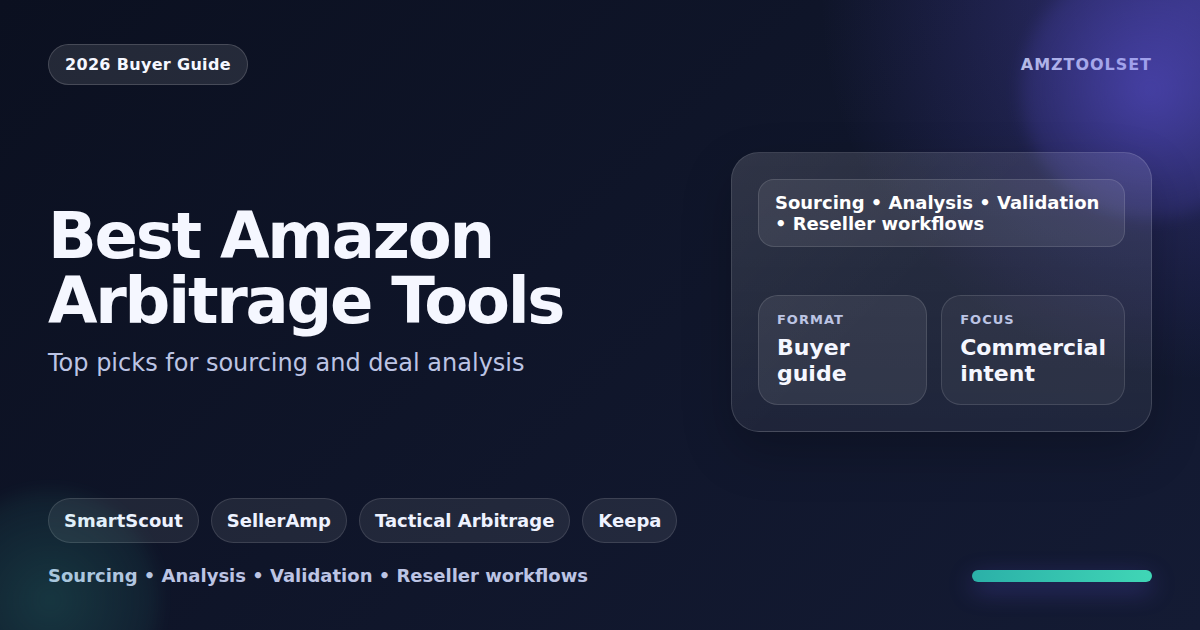
Amazon arbitrage sellers usually do not need one magic tool. They need the right stack.
Best for brand, seller, and market research
If you need more leads, start with a sourcing engine like Tactical Arbitrage. If you already have leads and need faster buy decisions, a deal analyzer like SellerAmp or Seller Assistant makes more sense. And if your edge comes from brand, subcategory, and seller research, SmartScout is the stronger pick.
My practical shortlist looks like this:
- Best for wholesale and brand discovery: SmartScout
- Best for broad sourcing: Tactical Arbitrage
- Best for fast deal analysis: SellerAmp
- Best lightweight analysis option: Seller Assistant
- Best validation baseline: Keepa
Quick answer box
| Snapshot | Recommendation |
|---|---|
| Best overall stack logic | Pair a sourcing or intelligence tool with a fast analyzer and Keepa as the validation baseline |
| Best for wholesale / reseller research | SmartScout |
| Best for pure sourcing volume | Tactical Arbitrage |
| Best for fast buy decisions | SellerAmp |
| Best low-friction analyzer | Seller Assistant |
| Best baseline every arbitrage seller should understand | Keepa |
Quick picks by arbitrage job
| Job | Best tool | Why it wins |
|---|---|---|
| Brand and market discovery | SmartScout | Best for seeing sellers, brands, subcategories, and market structure before chasing individual SKUs |
| Broad online arbitrage sourcing | Tactical Arbitrage | Strong fit when you want lots of sourcing paths and filters |
| Fast buy/no-buy analysis | SellerAmp | Built for fast profit, fees, ROI, and restriction checks |
| Lightweight analyzer workflow | Seller Assistant | Good for sellers who want quick evaluation without a bulky sourcing stack |
| Historical validation | Keepa | Useful baseline for price history, rank trends, and offer behavior |
| Retail-focused evaluation | BuyBotPro | More automation-heavy decision support for retail arbitrage workflows |
| UK/EU-friendly sourcing angle | SourceMogul | Cleaner fit for some sourcing workflows outside the usual US-first stack |
Comparison table
| Tool | Best for | Strongest strength | Main limitation | Best seller type |
|---|---|---|---|---|
| SmartScout | Wholesale, brand research, market mapping | Seller and category intelligence | Not the best fit if you only want simple SKU-level OA sourcing | Wholesale and research-heavy sellers |
| Tactical Arbitrage | Online arbitrage sourcing | Broad sourcing coverage and filtering | Can feel heavy for beginners | Sellers who need more leads |
| SellerAmp | Deal analysis | Fast buy-decision workflow | Not a sourcing engine | Online arbitrage operators |
| Seller Assistant | Lightweight analysis | Quick checks and practical evaluation | Less of a market-mapping tool | Sellers who want a simpler analyzer |
| BuyBotPro | Retail arbitrage evaluation | Automated decision help | Narrower than a full sourcing stack | Retail arbitrage users |
| Keepa | Validation and trend checking | Price/rank history baseline | Not a full arbitrage platform | Almost everyone |
| SourceMogul | Sourcing | Focused sourcing workflow | Smaller ecosystem than bigger names | UK/EU or sourcing-first sellers |
| ArbiSource | Lead lists / sourcing support | Saves time on finding leads | Less control than building your own sourcing workflow | Sellers who want speed over depth |
| ArbitrageHero | Supporting workflow automation | Helps with reseller process efficiency | Less essential than top-tier sourcing and analysis tools | Operators optimizing an existing process |
| Nepeto | Adjacent reseller workflow tool | Can help with operational efficiency in the right stack | Not the category-defining pick for most buyers | Niche reseller workflows |
The best Amazon arbitrage tools by workflow
Best for wholesale and brand discovery: SmartScout
If your arbitrage or reseller edge comes from understanding who is selling, what brands are active, where the gaps are, and which subcategories are worth digging into, SmartScout is one of the most useful tools in the category.
That matters because a lot of sellers treat arbitrage like random SKU hunting. SmartScout is better when you want a higher-level map first.
Use it if you want to:
- find brands with weak seller coverage
- explore subcategories before sourcing individual products
- study competitor storefronts and seller patterns
- build wholesale or reseller lists from market structure, not guesswork
Skip it if your main need is just scanning one deal faster. For that, SellerAmp or Seller Assistant is a better fit.
Best for broad sourcing: Tactical Arbitrage
Tactical Arbitrage is still one of the strongest options when the main problem is lead generation at scale. It is the tool for sellers who want to cast a wide net across sourcing paths, then filter aggressively.
It makes the most sense when you:
- need more sourcing volume
- already understand your buy criteria
- are willing to spend time tuning filters
- want a more systematic sourcing workflow than one-off manual hunting
The downside is obvious: more power usually means more complexity. Tactical Arbitrage is not the easiest starting point for someone who is still learning what a good deal looks like.
Best for fast buy decisions: SellerAmp
SellerAmp is one of the clearest answers to the question: should I buy this product or not?
That makes it different from sourcing engines. It is not mainly about finding opportunities from scratch. It is about evaluating opportunities fast enough to keep your workflow moving.
SellerAmp is strongest when you want to check:
- ROI
- estimated profit
- fees
- sales rank context
- competition
- potential restrictions
If your current bottleneck is analysis speed, SellerAmp can be more useful than adding another sourcing engine.
Best lightweight analyzer: Seller Assistant
Seller Assistant fits sellers who want a practical analyzer without making the workflow feel too heavy.
It is useful for operators who already have products in front of them and need a faster way to qualify them. It can also bridge into analytics and reseller-style workflows better than some narrower tools.
Use it if you want:
- a lighter analysis flow
- practical product checks
- less setup friction than a larger sourcing stack
It is not the best option if your main need is full market mapping or large-scale sourcing breadth.
Best retail arbitrage decision tool: BuyBotPro
BuyBotPro makes more sense for sellers who want more automated guidance in retail arbitrage-style decisions. That can be useful if you are scanning lots of possible buys and want stronger go/no-go support.
The tradeoff is that this kind of tool works best when it matches your workflow closely. If it does not, it can feel like too much system for not enough advantage.
Best validation baseline: Keepa
Keepa should not be treated like a full arbitrage platform. It is better treated as the baseline validation layer almost every arbitrage seller should understand, because price history, sales-rank movement, and offer behavior help you avoid bad assumptions.
Keepa is especially useful for:
- checking whether a good-looking margin is actually stable
- spotting price tanking or offer volatility
- validating seasonality and historical movement
- grounding sourcing ideas in real marketplace behavior
If you only use one lightweight research tool in addition to an analyzer, Keepa is often the most practical one.
Beginner online arbitrage vs wholesale-heavy workflows
A lot of roundup pages blur these together. That is a mistake.
Best stack for beginner online arbitrage
A simpler starter stack looks like:
- Tactical Arbitrage or SourceMogul for sourcing
- SellerAmp or Seller Assistant for analysis
- Keepa for validation
This works best for sellers who want to find leads, check margins, and reduce obvious mistakes.
Best stack for wholesale or reseller-heavy workflows
A more advanced stack looks like:
- SmartScout for market mapping and brand research
- SellerAmp or Seller Assistant for product-level checks
- Keepa for historical validation
This is stronger for sellers who care about broader category opportunity, seller patterns, and brand-level gaps before deciding what to source.
Best arbitrage stacks by seller type
If you are brand and category driven
- SmartScout
- Keepa
- optional SellerAmp
If you need more sourcing volume
- Tactical Arbitrage
- SellerAmp
- Keepa
If you want simpler decision support
- Seller Assistant
- Keepa
- optional sourcing add-on later
If you mainly do retail arbitrage
- BuyBotPro
- Keepa
- optional SellerAmp depending on workflow
If you are UK/EU sourcing first
- SourceMogul
- SellerAmp or Seller Assistant
- Keepa
How to choose the right Amazon arbitrage software
Start with the bottleneck, not the brand name. Ask yourself:
- Do I need more leads, or better decisions on the leads I already have?
- Am I doing online arbitrage, retail arbitrage, or wholesale/reseller research?
- Do I need market intelligence, or just product-level analysis?
- Am I trying to save time, or gain deeper visibility?
That framework usually leads to better choices than comparing long feature grids.
My verdict
If I had to keep this simple:
- choose SmartScout if you care most about seller, brand, and market intelligence
- choose Tactical Arbitrage if you need broad sourcing power
- choose SellerAmp if fast buy/no-buy analysis is the real bottleneck
- keep Keepa in the stack as your validation baseline
Most sellers do not need every tool on this list. They need the right combination for the workflow they actually run.
Still choosing an arbitrage stack?
Use this guide as your first filter. If you need a broader operating stack beyond sourcing and deal checks, move into the wider seller-software landscape with our roundup of the best Amazon seller tools.
Frequently Asked Questions
What is the best Amazon arbitrage tool overall?
There is no single best tool for every seller. SmartScout is strongest for market intelligence, Tactical Arbitrage for sourcing breadth, SellerAmp for fast analysis, and Keepa for validation.
What is the best tool for online arbitrage sourcing?
Tactical Arbitrage is one of the strongest picks when the main need is broad sourcing and filtering.
What is the best Amazon arbitrage analyzer?
SellerAmp is one of the clearest options for fast buy-decision analysis. Seller Assistant is also a strong lighter-weight option.
Do I need Keepa if I already use another arbitrage tool?
Usually yes. Keepa is still useful as a validation baseline because historical price and rank context can prevent bad buys.
Is SmartScout an arbitrage tool?
Yes, but it is better understood as a market-intelligence and reseller-research tool than a simple SKU-sourcing engine.