sellerboard Review: Is It Worth It for Amazon Sellers in 2026?
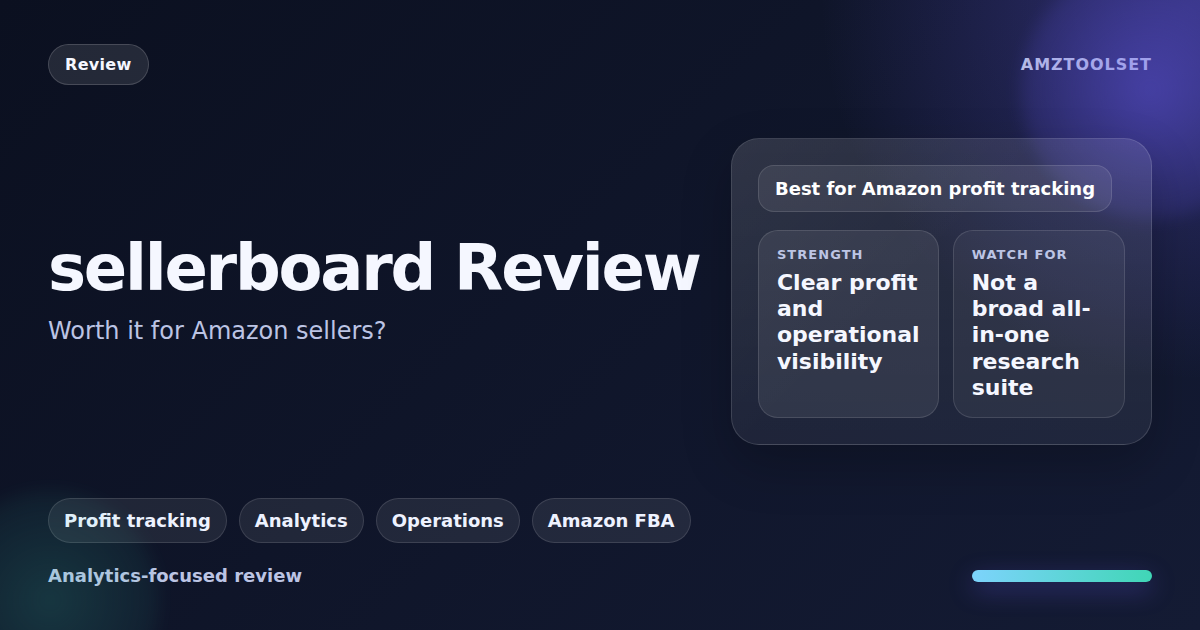
Short version: sellerboard is worth it if your main problem is profitability visibility, not tool breadth. If your bottleneck is the opposite one — mapping sellers, brands, and whole categories — start with SmartScout instead.
That is the real buying split. sellerboard makes sense when you care more about profit tracking, margin clarity, and day-to-day operating visibility than about product discovery, keyword research, or seller intelligence.
Our practical take: sellerboard is one of the strongest focused analytics tools for Amazon sellers who want cleaner financial and operational insight. It works better as a profit-control layer than as a replacement for a full research suite.
Still deciding at the category level? Compare the wider field in our best Amazon seller analytics tools guide, or read the SmartScout review if market mapping matters more to you than profit reporting.
Quick answer: is sellerboard worth it?
Yes — sellerboard is worth it for Amazon sellers who want tighter profit tracking and operational analytics than Seller Central or a broad suite usually gives them.
It is strongest when you want:
- clearer profit and margin tracking
- faster visibility into day-to-day performance
- a focused analytics layer instead of an all-purpose suite
- better operational visibility without buying a giant research stack
It is weaker when you want:
- product research and product discovery
- keyword research and reverse-ASIN workflows
- deep seller, brand, or category intelligence
- one tool that tries to do everything
sellerboard at a glance
| Snapshot | Our take |
|---|---|
| Overall verdict | One of the best focused Amazon profit-tracking tools |
| Best for | Margin-focused Amazon sellers and operators who want clearer profitability and operating visibility |
| Worst fit | Buyers who mainly need product research or keyword discovery |
| Strongest areas | Profit analytics, margin tracking, operational dashboards, cleaner P&L-style monitoring |
| Main limitation | Not an all-in-one research or market-intelligence suite — weaker for discovery and seller intelligence |
| Pricing feel | Easier to justify when better financial clarity affects real decisions |
| Learning curve | Usually lighter than broad all-in-one suites because the job is narrower |
| Trial / demo feel | Check the current public offer before making a final decision, because pricing and trial terms can shift |
| Best alternatives by workflow | SmartScout for seller intelligence, Helium 10 for all-in-one breadth, Amazon-native reporting for lightweight baseline needs |
sellerboard vs other common options
| Tool | Best for | Why choose it over sellerboard | Why stay with sellerboard instead |
|---|---|---|---|
| sellerboard | Profit tracking and operational analytics | You want focused profitability visibility | — |
| SmartScout | Seller, brand, and category intelligence | You care about market mapping more than internal profit reporting | sellerboard is cleaner if your real issue is profit visibility |
| Helium 10 | Broad all-in-one Amazon workflows | You want research, keywords, and listing support in one stack | sellerboard is simpler if you already have research covered |
| Amazon-native reporting | Lightweight baseline reporting | You want the cheapest basic starting point | sellerboard gives more practical day-to-day profitability framing |
What sellerboard does best
1. Profit tracking and margin visibility
This is the main reason to pay attention to sellerboard.
A lot of sellers do not actually need another giant software suite. They need a faster answer to practical questions:
- Which products are really profitable?
- Where is margin getting squeezed?
- Are fees, ads, or operating costs eating the gains I thought I had?
sellerboard looks strongest when that kind of operational clarity is the buying trigger. Instead of acting like a discovery engine, it works as a profit-control dashboard — which makes it especially useful for sellers who have moved past the “just find more products” phase and are now trying to protect and improve profitability.
2. Operational dashboards that are easier to act on
Focused analytics tools often beat big suites in one specific way: they feel easier to use because they are not trying to solve every Amazon workflow at once. That is a large part of sellerboard’s appeal.
If your daily routine is more about monitoring performance than doing fresh keyword or product research, a focused analytics layer is more practical than opening a broader system with ten unrelated modules.
It is also why sellerboard can make sense for sellers who already use other tools. It does not have to replace the stack — it can improve the part broad suites handle least elegantly: clear ongoing profitability visibility.
3. Better financial clarity than generic all-in-one reporting
Broad suites usually give you reporting because they have to. sellerboard makes more sense if reporting is the reason you are buying in the first place.
That does not automatically mean it beats every alternative at everything. It means the product is easier to justify when your buying lens is:
- margin monitoring
- operational awareness
- financial decision support
- cleaner readouts for an existing catalog
That is a different job from product discovery, listing building, or seller-intelligence research.
4. A good complement to a research stack
This is where a lot of review pages get too binary. You do not have to choose between a focused analytics tool and a broader suite as if only one can exist.
sellerboard can be a smart buy for sellers who already have:
- research covered by another tool
- enough keyword capability elsewhere
- a stable catalog that now needs better financial monitoring
In those cases the narrowness is not a flaw. It is the point.
Where sellerboard is weaker than some alternatives
1. It is not the right tool for product or keyword research
If your main buying question is “how do I find products, keywords, and listing opportunities?”, sellerboard is the wrong place to start. Those questions are better answered here:
sellerboard is not a bad tool because it is narrower. It is narrower on purpose.
2. SmartScout is stronger for seller and category intelligence
If your edge depends on understanding:
- who the strongest sellers are
- which brands dominate a niche
- how seller footprints overlap across categories
- where market opportunities are hiding
then SmartScout is the sharper choice. That is a clean workflow split: sellerboard helps more with internal operational clarity, SmartScout helps more with external market intelligence.
3. Helium 10 is broader if you want one ecosystem
Helium 10 is easier to justify if you want:
- product research
- keyword workflows
- listing support
- extension-led research
- one general all-in-one ecosystem
sellerboard is easier to justify when you do not need that breadth and would rather buy something more focused.
4. Amazon-native reporting may be enough for light users
This is the trust-first section most affiliate pages avoid: some sellers do not need paid analytics software yet. If your operation is still small, simple, or highly price-sensitive, Amazon-native reporting may cover enough of the baseline.
The reason to pay for sellerboard is not that more software is always better. It is that better clarity can support better operational decisions. If your current baseline already answers your main questions, the upgrade case is weaker.
sellerboard pricing and value
Pricing should be checked against the current public offer at implementation time, but the buying logic is already clear. The useful question is not “is sellerboard cheap?” — it is “will clearer profitability visibility change how I run the business?”
sellerboard is stronger value if you:
- manage a catalog where margin visibility really matters
- want faster operational insight without buying a giant suite
- already have research tools but need cleaner analytics
- make decisions where fee, ad, and profitability clarity can protect profit
sellerboard is weaker value if you:
- are still at a very early stage and mostly need basic reporting
- really need research and discovery tools, not analytics depth
- want one platform to cover nearly every Amazon workflow
- will not actively use performance and margin dashboards
sellerboard pros and cons
Pros
- Strong fit for profit tracking and operational analytics
- Easier to justify than a broad suite when analytics is the main job
- Useful for margin-focused sellers who already have research covered
- Cleaner positioning than generic ‘does everything’ software pages
- Can complement an existing stack instead of replacing it
Cons
- Weak fit for product research and keyword discovery
- Not the right tool for seller, brand, or category intelligence
- Less compelling for buyers who want one broad ecosystem
- Amazon-native reporting may be enough for lighter users
sellerboard vs SmartScout
This decision is mostly profit visibility vs market intelligence.
Choose sellerboard if you want:
- clearer profitability and performance visibility
- a more internal operational dashboard layer
- help monitoring the business you already run
Choose SmartScout if you want:
- seller and brand intelligence
- category and market mapping
- insight into competitor and seller behavior
If that is your main fork in the road, read the SmartScout review next.
sellerboard vs Helium 10
This one is mostly focused analytics vs all-in-one breadth.
Choose sellerboard if you want:
- a more focused analytics tool
- cleaner day-to-day profitability reporting
- less suite sprawl
Choose Helium 10 if you want:
- product research and keyword workflows
- one subscription across multiple seller jobs
- a broader software ecosystem
If you need the broader suite path, start with Helium 10 pricing.
Who should buy sellerboard?
Use sellerboard if you are:
- a margin-focused operator
- a seller who wants cleaner financial visibility
- someone who already has research covered elsewhere
- a team that cares more about operational dashboards than discovery tools
Skip sellerboard if you are:
- mainly shopping for product research software
- mainly shopping for keyword research depth
- trying to buy one suite for everything
- better served by SmartScout-style seller intelligence
Our real recommendation
Read this next
- Need broader analytics context? Read Best Amazon Seller Analytics Tools
- Comparing focused analytics vs market intelligence? Read the SmartScout review
- Want a broader all-in-one tool? Read the Helium 10 review
- Still building your overall stack? Read Best Amazon Seller Tools
Frequently Asked Questions
Is sellerboard worth it?
Yes, for sellers who care about profitability clarity and operational visibility. It is a much weaker buy if you mainly need research workflows.
What is sellerboard best for?
Profit tracking, margin visibility, and focused operational analytics for Amazon sellers.
Is sellerboard better than Helium 10?
Not as an all-in-one suite. sellerboard is better when your main goal is cleaner profitability reporting. Helium 10 is better when you want broader seller-tool coverage.
Is sellerboard better than SmartScout?
Not for market intelligence. SmartScout is the better choice for seller, brand, and category research. sellerboard is the better choice for internal profitability visibility.
Does sellerboard replace Amazon Seller Central reports?
Not automatically. It makes the most sense when native reporting no longer gives you enough day-to-day clarity or decision support.